
Traditional music in Ghana

By In-house West Africa
31 Mar 2016 - 14:26


By Arnie Baidoo
The traditional musicology of Ghana is divided geographically into two regions: the north and the south. Traditional music and the respective dance from the various ethnic groups are heavily linked to different types of musical instruments. With drums and gong-gongs more prevalent in the south, while string instruments and the calabash are used mostly in the north.
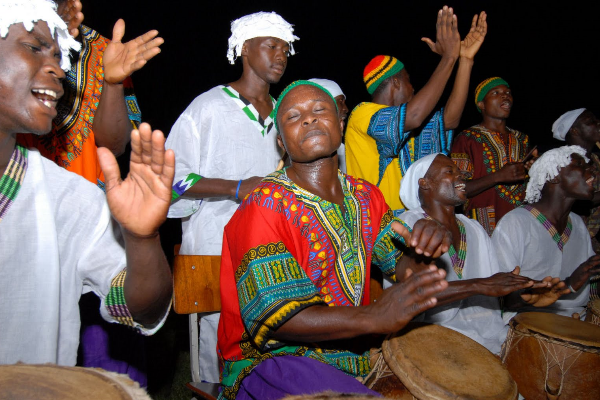
The south, which comprises mostly the Akan States, the Ga-Adangbe, the Ewe and the Nzema, make use of principally percussion instruments such as ‘Atumpan’, ‘Fontomfrom’, ‘Atsimemevu’, ‘Bomaa’, ‘Adowa drum’. The region also uses the ‘Seperewa’ harp-lute. The north uses predominantly stringed instruments such as the ‘kologo’ lute, the ‘gonjey’ fiddle, wind instruments such as flutes and horns. Aerophones, chordophones and idiophones such as the ‘goje’, xylophones, and castanets are also used.
Dances
Traditional music comprises singing, clapping, drumming and dance and performed at events such as funerals, ceremonies, festivals, weddings and other public and private gatherings. The various dance forms, which have historical meanings, linked to ancestral beginnings deities and gods, are inseparable from the traditional music. These include:
Bamaya
‘Bamaya’ is a dance of the Dagbamba people of the Northern region of Ghana which means – the river valley is wet. The dance is usually performed by men in ladies’ skirts and involves wiggling of the pelvis. This dance is based on the story of a man who abused his wife, resulting in a plague of famine for the region. It was revealed that, in order to make him humble to the wife, all the men in the village had to dress like women in showing humility to women in the area – hence the special dance costume.
Jira
The Dagomba people of the Dagbon traditional area in the northern part of Ghana perform this dance. The dance is believed to have emanated from a myth which classifies the dance as a dwarf’s kind of dance and not everyone sees this special dance.
Bawa
Also called ‘Bewaa’, the ‘Bawa’ dance is a recreational dance of the youth of Dagara community in the Upper West region, the northern sector of Ghana. This dance comes with movements that come with various expressions.
Takai
Performed during funerals and festivals, ‘Takai’ is a recreational circle dance of the Dagomba people. Usually danced with a stick, where the dancers turn around and each other with the stick.
Nmina
The calabash features prominently in this dance seen at social gatherings in the northern region. It is performed by women singing praise to their creator and their benefactors in life.
Adzogbo
Originally a war dance, the dance is now adapted as a social and recreational dance. Women begin the dance with ‘Kadodo’, a dance with elegant movement of the arms and taps and hops from the leading foot. Men follow in a series of energetic ‘Atsia’, performances which show their strength, dexterity and agility. This is a dance among the Ewe people in the Volta Region, within the southern sector of the country.
Agbadza
Another traditional dance of the Ewe tribe of the Volta Region, the ‘Agbadza’ is performed by men and women accompanied by drums, rattles and gong-gong. There are two main movements – a slow step where the arms move back and forth while extended downwards, and a fast step where the arms flap at the side with elbows extended.
Gahu
In the Ewe language, Gahu means “expensive” or “jewel”. It is a recreational dance which is characterized by its graceful movements, elegance and dignity.
Kple
A religious dance from Greater Accra, this dance is performed by priestesses at shrines during the Homowo festival, a festival for the Ga people in the southern sector. This dance is used to communicate with the gods to bring blessings.
Kpatsa
The formation of a human ring characterizes the dance which has social characteristics in its form and creates an avenue for the people to share the stories of the day through its rich musical accompaniment.
Kpanlogo
It is a recreational music and dance by the Ga-Adangbe people of Accra in the northern sector, Movements in the dance reflect themes such as social issues, politics, and expression of human emotions.
Fume Fume
The dancers wear grass skirts, characteristic to that of the ancient warriors of the land of the Ga people within the northern sector. It is a creative dance with explosive energetic movements.
Adowa
Referred to as the ‘Antelope dance’ because it mimics the jumping of an antelope, it is a recreational dance performed gracefully and athletically by men and women in Akan areas within the southern sector of the country.
Past and present proponents
Professor J.H. Nketia
Considered Africa’s premier musicologist, Professor Joseph Hanson Kwabena Nketia is an ethnomusicologist and composer who is considered a living legend and easily the most published and best known authority on African music and aesthetics in the world. His concept and interpretation of time and rhythmic patterns in Ghanaian and other African folk music are revolutionary, and have become standard for researchers and scholars around the world.
He has composed for both Western and African instruments, and has written more than 200 publications, including his world-acclaimed ‘The Music of Africa’, which has been translated into German, Italian, Chinese, and Japanese.
Kofi Ghanaba
Known as the ‘Divine Drummer’, Kofi Ghanaba (formerly known as Guy Warren) was a pioneer of the African renaissance, from a very young age believing strongly in staying true to his African roots. His pride in his African heritage and love of Africa was portrayed in every aspect of his life: his music, the way he lived, the things he stood for and even in the clothes he wore.
Originally a jazz performer, Ghanaba made a switch to drumming and was one of the first persons to infuse traditional drumming into jazz music. His ingenuity in mixing traditional music and jazz, earned him critical acclaim with the release of platinum albums such as A Swingin’ Safari (1962).
He was recognized and awarded worldwide by different organizations in recognition of his versatility and African drum playing powers. He died in 2008.
Koo Nimo
Koo Nimo’s legacy spans decades and after several years of making and propagating Ghanaian traditional music, the 80-year-old is still active with the music.
Many of his songs tell traditional stories and are sung in the local language Twi. Along with one or two guitars and vocals, the traditional Ashanti palm wine ensemble consists of traditional instruments of West Africa, including the ‘apentemma’ and the ‘donno’, the ‘frikyiwa’ (metal castanet), the ‘prempensua’ (rhumba box), the ‘ntorwa’ (hollow gourd rattle with beads or seeds woven around it on a net), and the ‘nnawuta’ (consisting of two iron bells that provide the key rhythmic pattern) or ‘dawuro’ (banana-shaped bell).
Wulomei
Wulomei (traditional priests and priestesses of the Ga people of Accra) remains the first indigenous group to lift traditional music to a pedestal, and were the only traditional group whose music gained radio airplay at a time when other genres of music were yet to do so.
The group’s instruments are indigenous, with ‘atenteben’ (bamboo flutes) and a lot of traditional local percussion that includes the giant ‘gombe’ (frame drums), which provides a deep percussive bass line. Wulomei play old traditional songs such as the Ga and Liberian sea shanties, ‘gome’ songs, the ‘kolomashie’ and ‘kpanlogo’ recreational songs of Accra and also Akan highlife music.
To portray the band’s indigenous orientation, members wear the white or yellow cloth and frilly hats of the real wulomei.
King Ayisoba
Born in Kalaga, a suburb in the Upper East Region of Ghana, Ayisoba plays the ‘kologo’, a traditional two-stringed guitar and attained local and international recognition for his brand of music.
In 2007, against all odds, he won the topmost award at the Ghana Music Awards with the song, ‘I Want To See You My Father’, a song that brought him much fame and popularity. He has been unable to sustain the same success after the 2007 breakthrough but continues to make a mark internationally, performing at major music festivals across the world.
Atongo Zimba
Atongo also plays the ‘koliko’ (or molo), a two-stringed lute, which is prevalent the savannahs and deserts of West Africa. He composes and sings in his native Fra Fra, and other local languages such as Hausa, Ga, Twi, as well as English.
The themes of his songs include power and respect in inter-personal and inter-ethnic relationships, issues of everyday life and development for Ghana and Africa generally as well as romantic love and spirituality. He has worked with internationally-acclaimed producers and performs at recognized music festivals and concerts across the world.
Conclusion
Traditional music in Ghana served as the backbone of Ghanaian music and birthed a generation of other genres of Ghanaian and African music. The prominence of traditional music was profound in the pre-colonial and early post-colonial years. Throughout the 1930s to the 1980s, highlife music, burger highlife and contemporary highlife, which were all born out of traditional music, took over the music scene.
In this age, the upsurge of hiplife and dancehall has relegated traditional music and its purveyors to social-gathering functions such as funerals and festivals. It lacks audience and mainstream appeal compared to other genres. Yet there are a few musicians who continue to remain true to their calling as traditional artistes despite the lack of attention from the media.


Most popular
Open call: AIR Festival 2026 seeks local talent in Knysna
04 Feb 2026
AI music firms, major labels clash over ‘Walled Garden’ model
04 Feb 2026
YouTube restricts background play to Premium users across all browsers
04 Feb 2026
Bruce Resnikoff appointed UMe chairman, Jamie Krents named CEO
04 Feb 2026
Interview: South African artist Nomisupasta
03 Feb 2026

Apple Music flags 2 billion fraudulent streams amid AI audio surge
03 Feb 2026

Disclaimer: Music In Africa provides a platform for musicians and contributors to embed music and videos solely for promotional purposes. If any track or video embedded on this platform violates any copyrights please inform us immediately and we will take it down. Please read our Terms of Use for more.

Subscribe to our monthly Newsletter
Follow us on social media


Please log in to post a comment.